


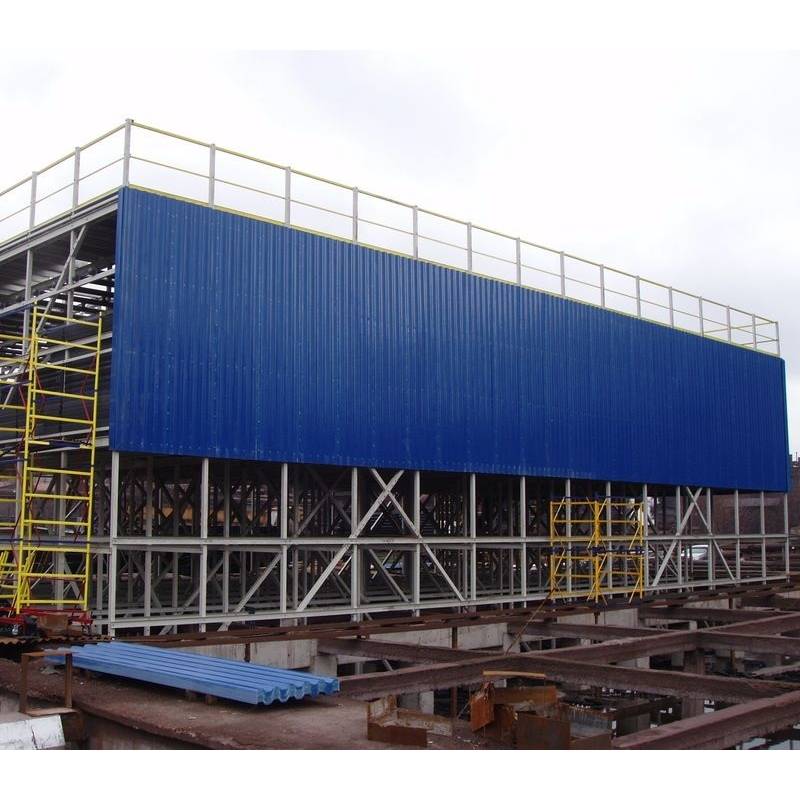

Cooling tower casing
Reliability and service life of fan cooling towers are largely determined by the type of material, strength and quality of enclosing structures (casing).
In winter, the temperature difference between the outside and inside the cooling tower can reach more than 60 °C, creating significant thermal stresses and discontinuities in the casing.
Casing discontinuities degrade fan operation and the cooling capacity of the fan cooling tower.
FRP casing is designed specifically for difficult, aggressive weather conditions and is the most modern and technologically advanced solution for fan-cooled cooling towers.
Fiberglass cladding is a corrugated fiberglass sheet with a thickness usually from 1.5 mm, and has a special coating (polymer resin) that protects fiberglass from ultraviolet radiation, prevents rapid aging, and enhances the strength properties of the material.
Fiberglass is the eponymous term for glass fiber reinforced polymers. One way to produce fiberglass is pultrusion, where glass fibers are fed into a machine, dipped in resin, passed through a mold that shapes and heats them, and exits the other side as a structural profile with a uniform cross section. Fiberglass gives the material the necessary strength, while resin provides uniformity and protection from adverse environmental conditions.
Benefits of using FRP in cooling towers:
- resistance to corrosion;
- high strength proportional to weight;
- simple and fast installation;
- low weight;
- low maintenance costs.
Fiberglass FRP is the best in terms of density. Despite the flexibility of FRP, which is high, in other structural parameters, FRP is the closest to steel of all materials. In addition, it is particularly fire resistant.
The corrosive environment of cooling towers requires right choice of building materials. FRP in its various designs meets the requirements for corrosion resistance, structural strength and stability over a wide temperature range and is therefore the most suitable for use in cooling towers.
| Specific weight | 2 kg/m³ |
| Tensile strength | 250 MPa |
| Bending strength | 250 MPa |
| Maximum operating temperature | 130 °C |
| Fire resistance | high |
Other products of this category
All rights reserved